
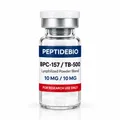

Anyone who wants to order BPC-157 legally in Germany finds two opposite answers online: a blanket yes and a blanket ban. Both are wrong. BPC-157 is not listed in any schedule of the German Narcotics Act (BtMG) and not in the New Psychoactive Substances Act (NpSG). It also has no approval as a medicine, not in the EU and, as far as we know, not in any other country. This makes it a research chemical that is sold for laboratory use and must not be used on humans. What this means in detail depends on four laws: the Narcotics Act, the New Psychoactive Substances Act, the Medicinal Products Act (AMG) with its import rules and the Anti-Doping Act. This article reflects the legal situation as of October 2026.
The short answer: not banned, not approved
In Germany, BPC-157 is not a narcotic and not a new psychoactive substance. Owning and buying it is therefore not a criminal offence in the way it would be for a listed substance. At the same time, BPC-157 is not an approved medicine. There is no product with this active ingredient that a doctor could prescribe or a pharmacy could dispense. What exists is the synthetic peptide as a research chemical, sold with the intended purpose “for laboratory research only”. This intended purpose is not a fig leaf. It is the legal framework: as soon as a substance is intended for use on humans, the Medicinal Products Act applies, and the substance then needs an approval, which BPC-157 does not have.
BPC-157 in the Narcotics Act and the NpSG
The Narcotics Act lists all narcotics in three schedules. Schedule I contains substances that may not be traded, Schedule II substances that may be traded but not prescribed, and Schedule III substances that may be prescribed. BPC-157 is in none of them, and neither is any other research peptide in our range. The New Psychoactive Substances Act (NpSG) covers groups of substances defined by their chemical structure, including phenethylamines, synthetic cannabinoids, benzodiazepines and tryptamines. Peptides belong to none of these groups. A pentadecapeptide such as BPC-157 therefore falls under neither the BtMG nor the NpSG. Anyone who claims otherwise confuses BPC-157 with substances that are actually listed.
This also means that the legal situation can change. The schedules are extended by ordinance. Before you order, check the current version of the schedules on gesetze-im-internet.de. The links are at the end of this article.
Why BPC-157 is still not a medicine you can buy
Section 2 (1) of the Medicinal Products Act defines medicines as substances that are intended for use on humans and are meant either to cure or relieve diseases or to influence physiological functions. The intended purpose is what counts. A peptide that a laboratory buys for cell assays or analytics is not a medicine within the meaning of the law. The same peptide, offered with dosage information for humans, would be one and could not be placed on the market without an approval. This is why every product page for BPC-157 states that it is a research chemical, and this is why you will not find any dosages, application recommendations or statements about effects on humans in our shop. This is not caution out of politeness. It is the condition under which a research peptide may be sold at all.
For you as a buyer, this means: when you order, you confirm that you are buying for research purposes and that you are of legal age. This confirmation is part of the contract, not just a click.
Import into Germany: what Section 73 AMG regulates
The import ban in Section 73 (1) AMG applies to all shipments to Germany, not only to parcels from non-EU countries. It applies as soon as the content is a medicine that requires an approval. The shipment may then only enter the country if the medicine is approved in Germany and the recipient belongs to a specific group: for shipments from the EU or the EEA, for example, pharmaceutical companies, wholesalers, pharmacies or hospitals (number 1), and for shipments from non-EU countries only recipients with a licence under Section 72 AMG (number 2). A private individual is never part of this group. A violation is an administrative offence under Section 97 (2) number 8 AMG with a fine of up to 25,000 euros.
The practical difference between the EU and non-EU countries lies in the checks, not in the ban. Parcels from non-EU countries go through customs, which can pass the content on to the medicines authority. Within the EU there is no customs border. The classification remains decisive. Whether a lyophilised peptide in a parcel counts as a medicine is decided by the authority based on the overall picture of packaging, labelling and the way the seller presents it. A product shipped as a research chemical without application information is different from a pen with dosing instructions. There is no guarantee. More about packaging and transport is on our shipping page.
BPC-157 and doping: WADA list and Anti-Doping Act
Sport is subject to a second legal level, and contrary to what is often claimed, it does involve German criminal law. The World Anti-Doping Agency lists BPC-157 by name in the 2026 Prohibited List under S0, non-approved substances. This class is prohibited at all times, in and out of competition. The German Anti-Doping Act (AntiDopG) builds on this: Section 2 (1) AntiDopG prohibits manufacturing, trading, supplying or prescribing doping substances from Annex I of the International Convention against Doping in Sport for the purpose of doping in sport. Under Section 4 (1) AntiDopG, violations can be punished with imprisonment of up to three years or a fine. Under Section 2 (3), acquiring and owning a not insignificant quantity for doping purposes is only prohibited for the substances in the annex to the AntiDopG. BPC-157 is not listed in this annex, unlike the secretagogue Ipamorelin, for example. For athletes subject to doping controls, the practical risk is a ban. For sellers, criminal law applies as soon as doping is the purpose.
What “for research purposes only” means legally
This sentence appears on every product page, on the label and in the terms and conditions. It sets the intended purpose that separates the product from the legal definition of a medicine. It is also a contractual commitment by the buyer: the buyer purchases for laboratory purposes, not for use on themselves or others. A seller who takes this framework seriously does not give dosages, does not sell pens or pre-filled syringes and does not answer questions about use on humans. A seller who does all of this and still writes “research use only” leaves the framework and turns the product into a medicine without approval. How else you can recognise a reputable seller, such as a certificate of analysis, a batch number and a legal notice, is explained on the page Buy research peptides.
What BPC-157 is and what the research says
BPC-157 is a synthetic peptide made of 15 amino acids. Its sequence comes from a protein found in human gastric juice. It was described in the early 1990s by the pharmacology research group at the University of Zagreb, which still provides most of the studies today. Almost all data come from animal and cell models. Controlled studies in humans are missing. This is exactly why there is no approval. Our guide BPC-157: structure, research and status summarises the structure, research areas and open questions.
Questions about the legal status of BPC-157
Does BPC-157 require a prescription?
No, but not because it is freely available. BPC-157 is not an approved medicine, so there is nothing a doctor could prescribe. As a research chemical, it is sold without a prescription to laboratories and adult buyers for research purposes.
Am I allowed to own BPC-157 in Germany?
Owning it is not a criminal offence under the Narcotics Act or the NpSG, because BPC-157 is not listed there. The Medicinal Products Act relates to placing on the market and import, not to owning a research chemical for laboratory purposes.
Does BPC-157 fall under the Anti-Doping Act?
Partly. Trading, supplying and prescribing it for the purpose of doping in sport are prohibited under Section 2 (1) AntiDopG, because BPC-157 is on the WADA list. Owning a not insignificant quantity under Section 2 (3) only concerns the substances in the annex to the AntiDopG, and BPC-157 is not listed there.
Sources
Medicinal Products Act, Section 2 (definition of a medicine): gesetze-im-internet.de/amg_1976/__2.html
Medicinal Products Act, Section 73 (import ban): gesetze-im-internet.de/amg_1976/__73.html
Medicinal Products Act, Section 97 (administrative fines): gesetze-im-internet.de/amg_1976/__97.html
Narcotics Act, Schedules I to III: Schedule I, Schedule II, Schedule III
New Psychoactive Substances Act, annex: gesetze-im-internet.de/npsg/anlage_1.html
Anti-Doping Act, Sections 2 and 4 and annex: Section 2 AntiDopG, Section 4 AntiDopG, Annex to Section 2 (3)
World Anti-Doping Agency, 2026 Prohibited List, class S0: wada-ama.org/en/prohibited-list
This article is general information as of October 2026 and not legal advice. All products in this shop are research chemicals for laboratory research and are not intended for use on humans or animals.